Conservation in Uganda does not hold because it is written into law. It holds because a Batwa guide, a conservancy landowner or a Samburu keeper earns more from a living forest than a cleared one. That calculation is what your booking pays for.
Where the money goes
- A 3% conservation and community levy on every journey, itemised on your invoice as its own line rather than buried in a nightly rate.
- 20% of park entry revenue is shared by law with the communities at Uganda’s park boundaries.
- Community-set fees at manyattas, sacred groves and cultural sites are set by the community, paid to the community, and never negotiated down by us.
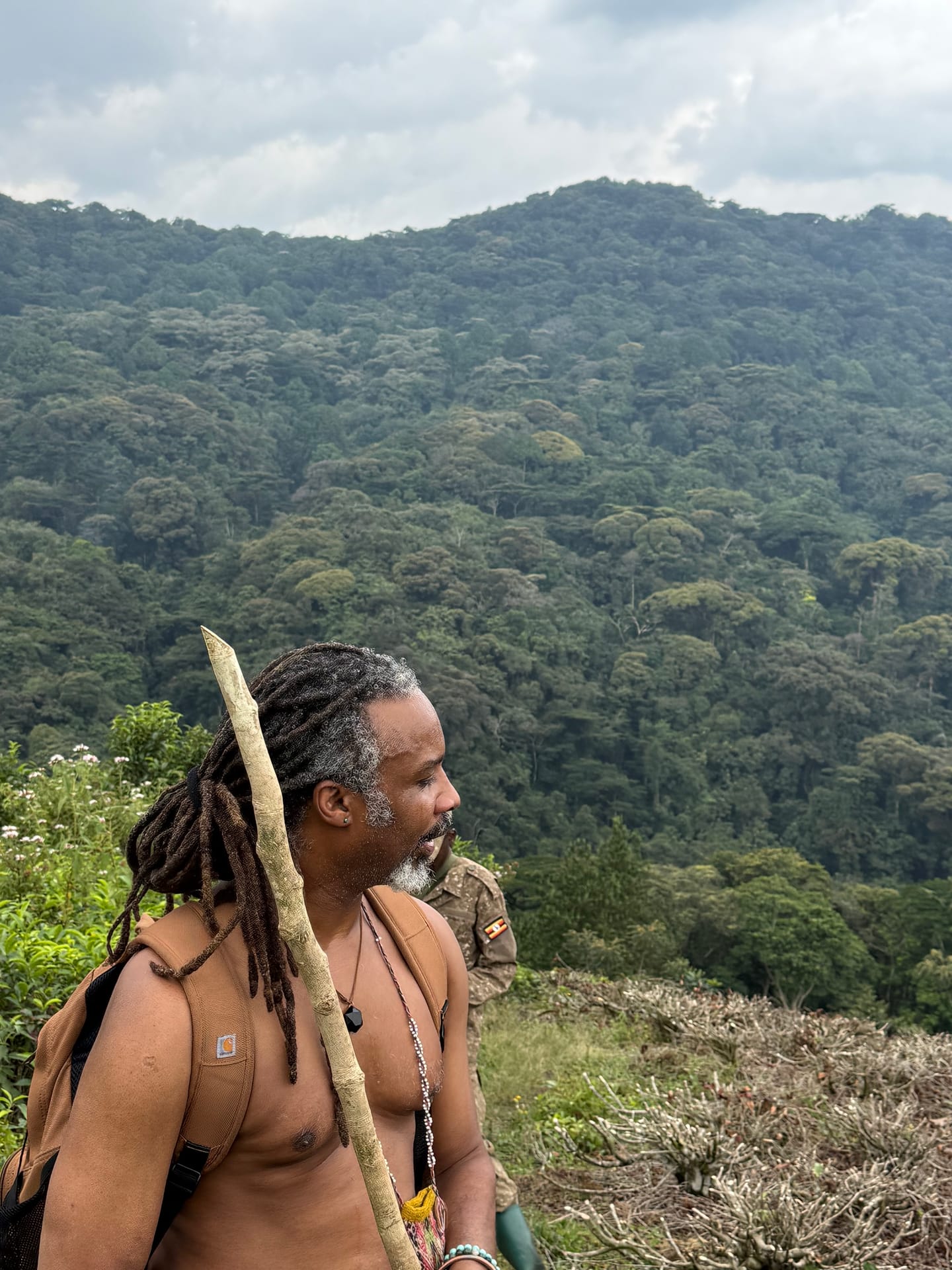
- Porter hire on treks is arranged for everyone whether or not you need one. It is the best-paid work at the forest edge.
Sacred sites
Some places on our passages are not attractions. They are working spiritual sites with living custodians and real rules.
Access is granted, not bought
Mparo’s inner shrine is the Bunyoro kingdom’s to open. It is sometimes closed. We tell you before you book, never at the gate.
Photography is asked for
Never assumed. At Nyero, at manyattas, at shrines — ask, and accept no as an answer.
Conditions are conditions
Shoes off at Karuzika. A kaniki cloth at Kaya Kinondo. Silence where you are asked for it. No touching pigment at Nyero, no climbing above the panels.
People
Our hosts have names and we print them. We do not stage villages, we do not photograph children without a guardian present and consenting, and we do not use anyone’s image as scenery. If you would not photograph a stranger’s kitchen at home, do not photograph one here.
Wildlife
- Seven metres minimum from gorillas and chimpanzees, and the hour is an hour.
- If you have a cold you will be turned back at the briefing. They catch what we carry.
- No off-road driving to crowd an animal, no baiting, no calls played to draw birds in during breeding season.
- We book conservancies with capped vehicle numbers over open-access sectors wherever there is a choice.
Operators we will not use
Any Kilimanjaro or trekking operator outside the KPAP porter-welfare partnership. Any lodge that cannot tell us who owns it. Any “cultural experience” where the community is paid a flat fee by a middleman rather than setting its own price.
Carbon
We will not tell you flying to Uganda is carbon neutral, because it is not. What we can say is that your journey is routed to reduce internal flying, that we favour lodges running on solar and rainwater, and that we would rather fund a ranger salary than buy an offset certificate.
Last updated 2 August 2026 · Sacred Earth, Kampala, Uganda